
The Nowhere 100
Who Actually Runs the World, and Where That Power Sits

Why I built it
Two years ago, I set out to answer a deceptively simple question: which cities have built the most complete ecosystem of infrastructure, culture, finance, sport, and connectivity? That became the Global Metro Power Rankings, a 16-dimensional score across more than 4,000 metros. Then I put every sports team on the same map in Every Metro Keeps Score.
The whole time, one question kept nagging. I had ranked the stage. I had not ranked the actors. Every list of “the most powerful people” I could find was a magazine editor’s dinner-party guess, reshuffled once a year and defended by nobody. Power, though, is not free-floating. It sits somewhere. A president is only as powerful as the state he commands; a mayor as the metro she runs; a CEO as the company he steers; a striker as the club that pays him. Power has an address.
So I gave it one. The Nowhere 100 scores each person by the Metro Power of the place or institution behind them, weighted by how much control they actually hold, and then it links every single name back to that place on the map. It is opinionated, transparent, dated, and unlike any other power list, it shows its work.
How to read it
The core formula is one line: power equals the Metro Power score of a person’s jurisdiction, times an influence weight for how much of that jurisdiction they actually command. A head of state in a full autocracy captures nearly all of their country’s weight; a prime minister checked by coalitions and courts captures roughly half. On top of that sits a geopolitical multiplier for the nuclear and energy powers whose clout outruns their economy.
A few things are worth knowing before you scroll.
Fifteen kinds of power, not one. Heads of state share the board with central bankers, governors and mayors, judges, multilateral and alliance chiefs, corporate CEOs ranked by market cap, financiers ranked by assets under management, media owners, sports-governance figures, cultural icons ranked by reach, sovereigns, faith leaders, and billionaires ranked by net worth.
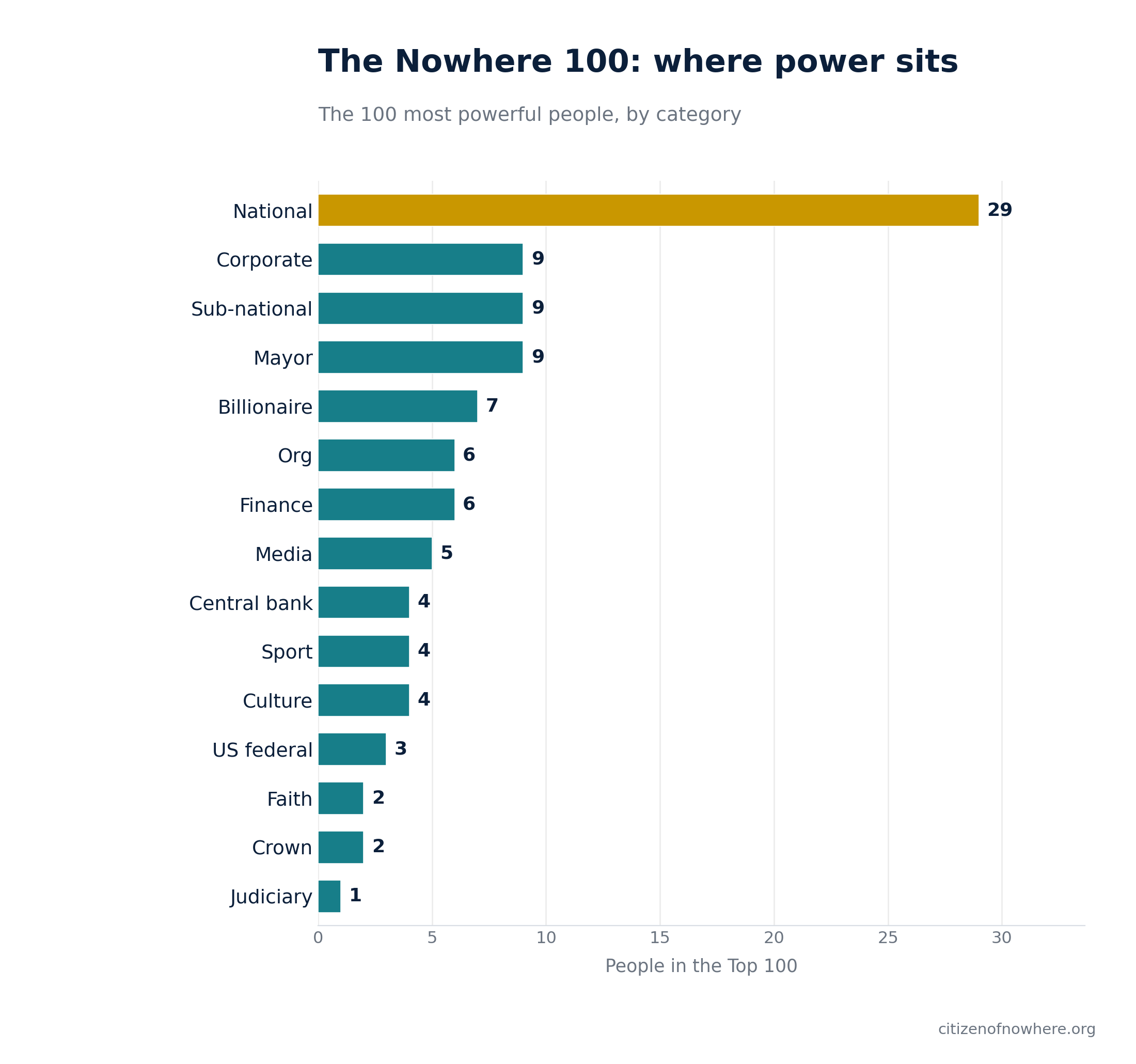
A filter for the purists. Some readers will find it absurd to have a footballer or a pop star on a power list. Toggle to “Office and wealth” and the media, sport, culture, royalty, and faith entries vanish, leaving only formal office and economic control. Both views are legitimate; the toggle just decides how wide you want the tent.
A clock for what is about to change. A small hourglass marks anyone facing a leadership change or election in roughly the next six months. As I write, it sits on Keir Starmer, who is resigning as the United Kingdom hands its premiership to Andy Burnham; on António Guterres, whose UN term ends in December; and on Mike Johnson and John Thune, whose grip depends on the November midterms.
A date, always. This is a snapshot, not a monument. Every entry carries an “as of” date, because power in July is not power in December.
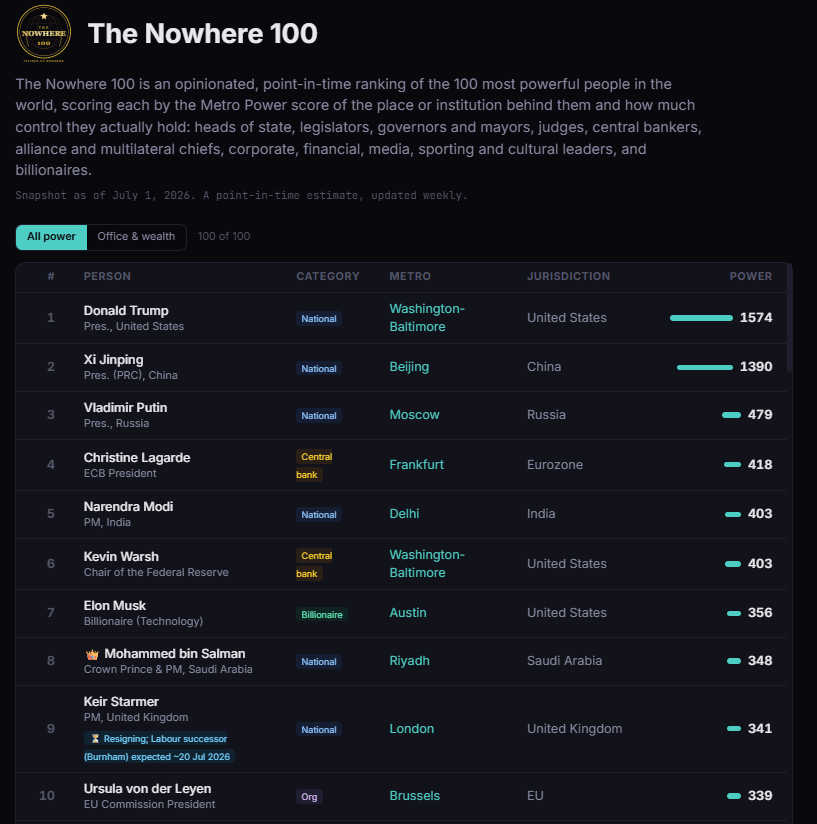
The top ten, and why the order will annoy you
Donald Trump, President of the United States
Xi Jinping, President of China
Vladimir Putin, President of Russia
Christine Lagarde, President of the European Central Bank
Narendra Modi, Prime Minister of India
Kevin Warsh, Chair of the Federal Reserve
Elon Musk
Mohammed bin Salman, Crown Prince of Saudi Arabia
Keir Starmer, Prime Minister of the United Kingdom
Ursula von der Leyen, President of the European Commission
The interesting part is not the top. Trump and Xi sit where everyone expects. The interesting part is what the model surfaces below the fold, and where it plants its flag.
Capital outranks cabinet. Larry Fink of BlackRock, steward of some twelve trillion dollars, lands at twelve, one spot above the Chancellor of Germany. That is a claim, and I will defend it: the money that moves markets is a more durable lever than a coalition government that could fall next quarter.
The Pope, but not only the Pope. Faith is real power, so Leo XIV sits at fourteen on the reach of 1.3 billion Catholics. The harder call was that the Grand Imam of Al-Azhar, the leading authority in Sunni Islam, also belongs on the board. Representing one faith and not the others was its own kind of statement.
Nuclear weight versus economic weight. Kim Jong-un commands a bomb and total control of his state, yet North Korea’s tiny economy drags him to the thirties. I tuned the model hard on exactly this tension, adding a coercive-power multiplier so the arsenals are not buried by GDP, and it is still the most contestable seam in the whole thing.
Culture is power with an asterisk. Cristiano Ronaldo and Taylor Swift share a page with heads of state, scored on planetary reach rather than any office. Roger Goodell makes it on the sheer economic mass of the NFL. If that offends you, the toggle is right there. That it is a live argument is the point.
Beyond people: two more ways to rank the world
The same engine that ranks people ranks nations and moments.
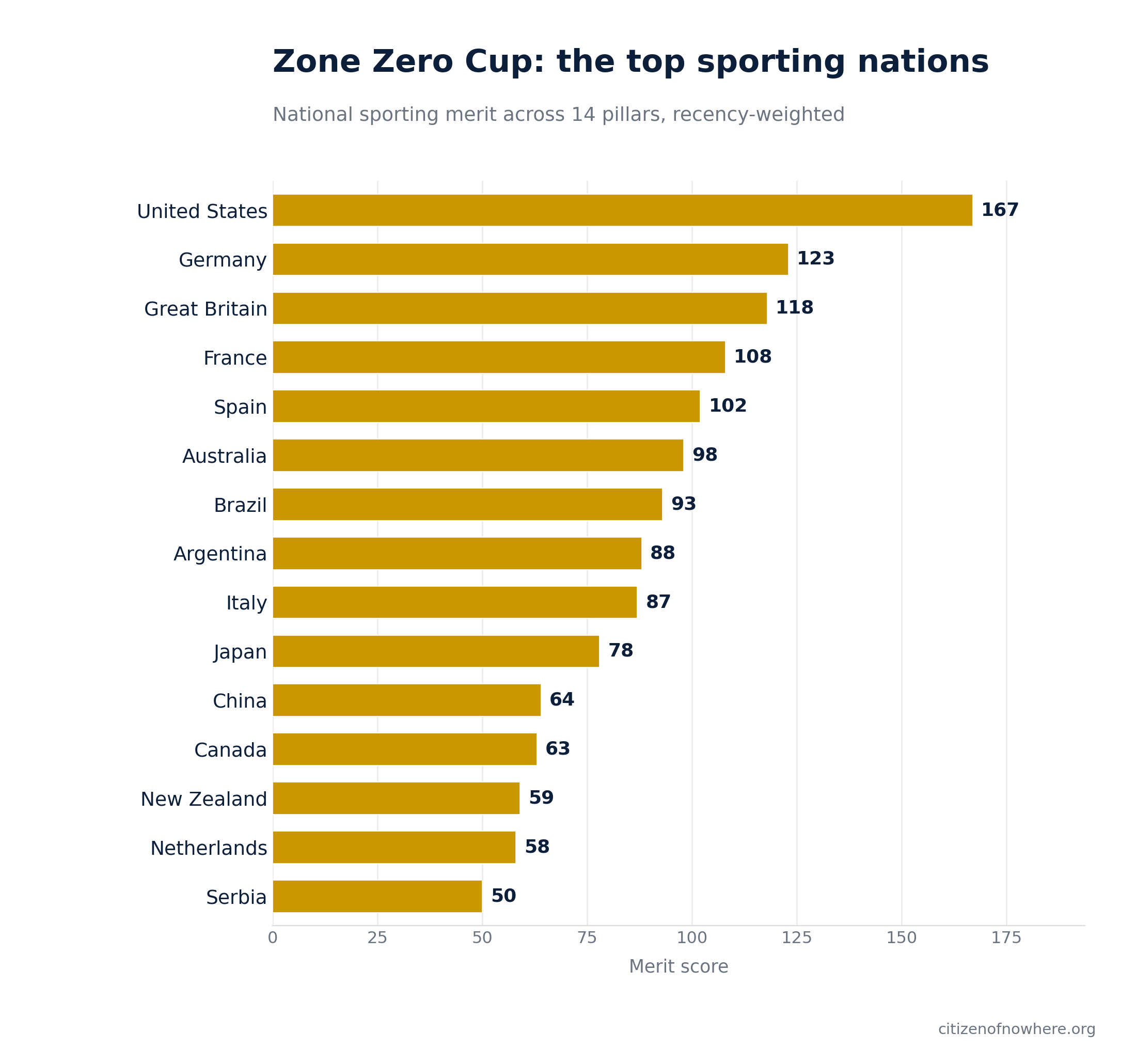
The Zone Zero Cup is a single table of national sporting merit across fourteen pillars, modeled on the college Directors’ Cup but built for countries. It weighs recent achievement far more heavily than distant glory, on an eight-year half-life, so it reflects who is strong now rather than who hoarded medals a century ago. The United States leads, but switch to the per-capita or per-GDP view, and the story flips to whoever punches hardest above their size.
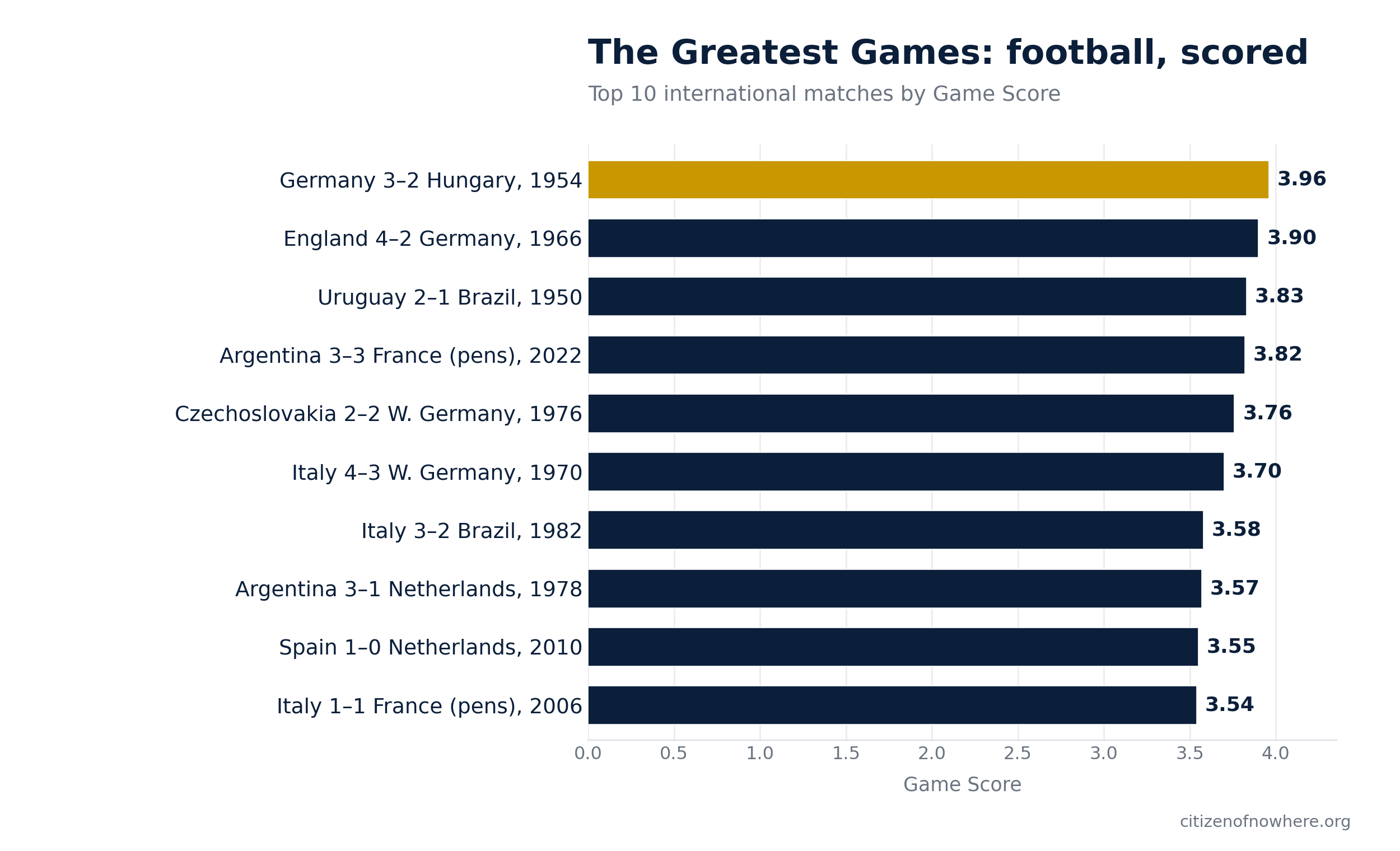
The Greatest Games does the same for individual matches. Every postseason game in International Football, NFL, NBA, NCAA Football & Men’s College Basketball, and MLB gets a Game Score that blends stakes, quality, and how close it actually was, so a first-round upset and a Game 7 classic can sit on one ladder. Football’s greatest matches join too. The 1954 Miracle of Bern still tops the board, ahead of the 1966 final at Wembley and the Maracanazo of 1950.
How often it updates
Once a week, automatically. Every Monday, a single job refreshes the world’s leaders, the billionaire net worths, the team valuations, and the ranking itself, and publishes without triggering a rebuild. The World Cup moves faster, on the half-hour live cycle above. The editorial dials, the weights, and the reach estimates are mine to turn, and I turn them in the open. Nothing here is a black box, and nothing here waits for me to remember to update it.
How it is built, and where it could be wrong
The full method, including all weights, is on the methodology page. National leaders scale with the V-Dem Liberal Democracy Index; billionaires convert net worth to the same scale at a discount; corporate chiefs run on market cap, financiers on assets, and the softer categories on estimated global reach, which is deliberately the most arguable input on the board.
And here is the honest caveat. The further this model travels from formal office and hard money toward reach and culture, the more it becomes an argument rather than a measurement. A model that puts a governor above most prime ministers, or a striker above a central banker, is making a case, not stating a fact. That is why the toggle exists, why the methodology is public, and why the whole thing is dated. I would rather be transparently wrong and improvable than confidently vague.
Go argue with it
The fastest way to understand The Nowhere 100 is to open it, sort it, filter it, and find the placement that makes you angry. Then follow the link under that person’s name to the city or institution behind them, and see whether the anger survives the map.
Open The Nowhere 100. Tell me who is ranked too high, who is missing, and which category I have not built yet. This publication has always belonged to the network rather than the nation. So does its map of power.
Data vintage: The Nowhere 100 as of the snapshot date shown on the page; leader, billionaire, and valuation feeds refreshed weekly; World Cup results live via the public match feed. Market odds from published outright boards. Figures are an opinionated model, not an official record. This is analysis, not investment or betting advice.
Protocol check for this piece. Structured comparison: category breakdown plus the annotated top ten. Graphics: three custom charts (category composition, Zone Zero Cup top 15, Greatest Games football) plus two live screenshots. Inbound links: /power, /sports/zone-zero-cup, /sports/games, /teams/national, /methodology, and several /countries and /rankings pages. Cross-links: the Global Metro Power Rankings opener and Every Metro Keeps Score. Methodology anchor: linked above.
Fascinating way to create a quantitative ranking of "power" . Great work.